Wellness® CORE Small Breed Healthy Weight Study
Grain-free super-premium diet, proven effective weight loss for small breed dogs.
While many studies for canine obesity have been conducted in general dog populations, few studies have focused on small-breed dogs. Small breeds have unique metabolic differences and behaviors that can affect their tendency to gain weight and, as a result, physiological responses to dietary treatments.1-2 Notwithstanding these variations, various therapeutic or scientific weight-modifying diets have been created and corroborated mainly in medium- or large-breed dogs, leaving clinicians with insufficient support of breed-size in particular for obesity in toy and small breeds.
In addition, pet parents are continuing to embrace diets that are high in protein and free of grains, perceiving them as being healthier and appealing for their pets. It has been demonstrated that a high protein formulation will increase satiety, help retain lean body mass and support fat-to-lean ratios at the time of a metabolic weight loss.3-4 As small-breed dogs have higher protein requirements on a body weight basis, it is clinically important to evaluate diets designed to achieve these nutritional properties in favor of a healthy, compositionally beneficial weight loss. Specialized diets developed and proven in small-breed dog nutrition could enhance how precisely and practically the vet weight management program works.
To address this gap, Wellness conducted a study evaluating a test diet that became Wellness CORE Small Breed Healthy Weight, a high-protein, grain-free, extruded diet for weight loss in adult small breed dogs. Findings demonstrate that these diets support safe and effective weight and fat reduction while maintaining lean mass, in small breed dogs.
STUDY AND RESULTS
Fifteen adult small breed mix dogs (6.5-15.59 kg) met the inclusion criteria: body condition score ≥ 6/9, body fat percentage ≥ 35%, and no preexisting medical conditions that could interfere with weight loss. These dogs ranged from 4.7 to 7.9 years old, with six males and nine females, and a mix of intact and neutered individuals.
The test diet was a turkey-based, grain-free extruded kibble formulated to meet AAFCO nutrient profiles for canine maintenance. It had a macronutrient dry matter profile of 40.53% protein, 13.37% fat, 30.1% Carbohydrate, with 6.22% crude fiber.
The experimental period consisted of a 10-week calorie-restricted weight-loss phase followed by a 6-week maintenance phase. During the weight-loss phase, dogs were initially fed 0.85 × RER of the test diet and adjusted weekly to target a safe weight-loss rate of 1–2% per week. By the end of the second week, all dogs’ offerings were reduced to 0.73 × RER. During the maintenance phase, dogs were fed 0.95 × RER with continued monitoring. The test diet served as the sole source of nutrition throughout the study.
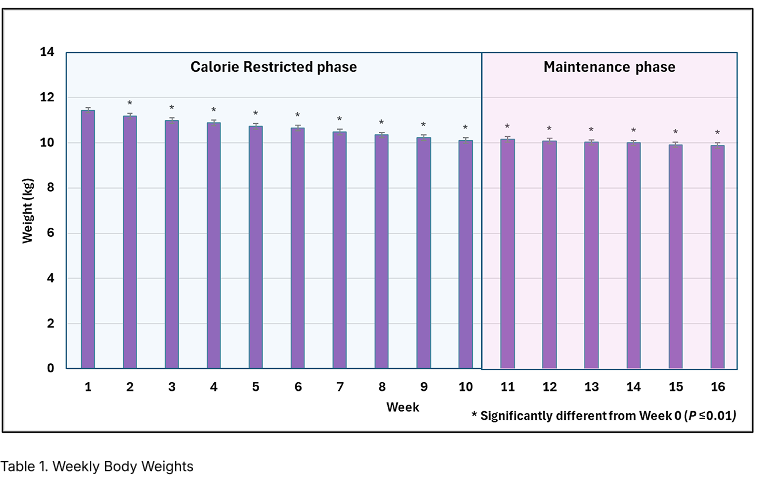
Body weights were recorded weekly. During the 10-week calorie-restricted period, weights decreased by an average of 1.23kg /10.30% with statistical significance by Week 2 (Table 1). All dogs on the panel lost weight. During the maintenance feeding period, none of the dogs regained weight.
Body condition score (BCS) was assessed on Days -1, 21, 49, and 70 using the WSAVA 9-point scale. BCS showed a significant decrease (P≤0.01) from an average score of 6.4 at the start of the study to 5.67 at 10 weeks while maintaining a safe rate of weight loss. Dual-Energy X-ray Absorptiometry (DEXA) scans were conducted at the same time points as the BCS to evaluate fat mass, lean mass, bone mineral content, and percent body fat.
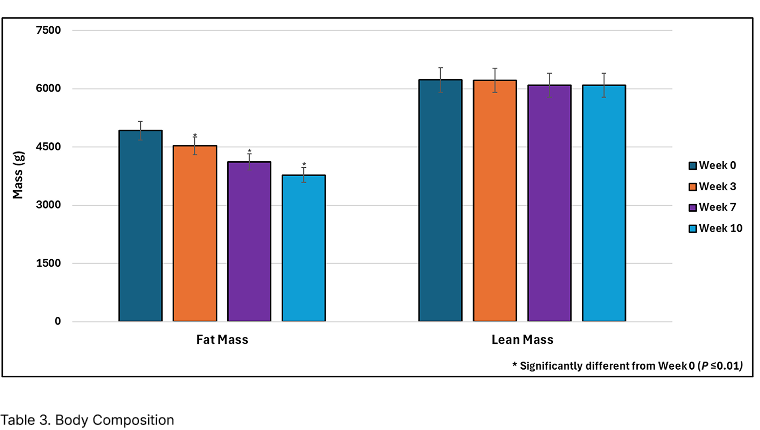
DEXA results (Table 2) showed that fat mass decreased by an average of 1.14kg/23.21%, while lean mass stayed relatively stable. This is further demonstrated by the average fat:lean ratio, which decreased from 0.81 at Week 0 to 0.65 at Week 10. Reduction of both fat mass and fat:lean ratios was significant (P≤0.01) by Week 3.
Hematology and chemistry panels were taken at baseline and at Week 10. All dogs were deemed healthy on exam and bloodwork was normal at the conclusion of the calorie-restricted phase.
CONCLUSION
This study demonstrates that small-breed dogs can safely and effectively lose weight on a high-protein, grain-free diet specifically evaluated for their needs. Dogs fed CORE Small Breed Healthy Weight achieved significant reductions in body weight, body fat, and fat:lean ratio within 10 weeks while maintaining lean mass and overall health, and none regained weight during the maintenance phase.
By providing data specific to small breeds, Wellness CORE Small Breed Healthy Weight offers veterinarians a more precise, evidence-based option that meets both clinical goals and owner preferences.
REFERENCES
- Burger, I. H., & Johnson, J. V. (1991). Dogs large and small: the allometry of energy requirements within a single species. The Journal of nutrition, 121, S18-S21.
- Morros-Nuevo, A., Salt, C., Pavey, J., F Wainwright, J., Dittmann, M., Keep, B., Wallis, N.J. and Raffan, E. (2026). Behavioural susceptibility to environmental influences in obesity–evidence from a companion animal model. BMC Veterinary Research, 22(1), 3.
- Hannah, S. S., & Laflamme, D. P. (1998). Increased dietary protein spares lean body mass during weight loss in dogs. J Vet Intern Med, 12(3), 224.
- Weber, M., Bissot, T., Servet, E., Sergheraert, R., Biourge, V., & German, A. J. (2007). A high‐protein, high‐fiber diet designed for weight loss improves satiety in dogs. Journal of veterinary internal medicine, 21(6), 1203-1208.