Wellness® CORE Healthy Weight Study
Grain-free super-premium diets, proven effective for weight loss.
Veterinarians today are well aware of the pet obesity epidemic, and the emotional and clinical complexity that accompanies it. Helping clients recognize that their beloved dogs are overweight and guiding them through the challenges of change can be difficult. Historically, prescription and science-brand commercial weight control diets are effective for reducing total body weight but can inadvertently contribute to loss of lean muscle. And even when success is achieved, it can be short-lived if the prescribed diet isn’t both palatable and aligned with client expectations.1-3
Meanwhile, many pet parents remain committed to high-protein, grain-free diets, formats they perceive as high-quality. High-protein formulations have been shown to enhance satiety, preserve lean body mass, and improve fat-to-lean ratios during weight loss. 4-5 Examining these diets’ potential to promote healthy, compositionally favorable weight loss is both timely and clinically relevant.
To address these gaps, Wellness conducted a study evaluating a test diet that became CORE Healthy Weight: a high-protein, grain-free, extruded diet for weight and fat loss in adult dogs. A palatability study was also conducted with CORE+ Healthy Weight, which has the same base kibble plus freeze-dried pieces comprised of turkey hearts and livers. Findings demonstrate that these diets not only support safe and effective weight and fat reduction while maintaining lean mass, but also meet client expectations for ingredient quality and palatability. These diets effectively bridge the gap between clinical efficacy and consumer preference.
STUDY AND RESULTS
Fifteen adult dogs met the inclusion criteria: body condition score ≥ 6/9, body fat percentage ≥ 35%, and no preexisting medical conditions. These dogs ranged from 2 to 8 years old, with twelve males and three females, and a mix of intact and neutered individuals.
The test diet was a turkey-based, grain-free extruded kibble formulated to meet AAFCO nutrient profiles for canine maintenance. It had a macronutrient dry matter profile of 39.5% protein, 11% fat, 34.5% carbohydrate, with 6% crude fiber.
The experimental period consisted of a 10-week calorie-restricted weight-loss phase followed by a 6-week maintenance feeding phase. During the weight-loss phase, dogs were initially fed 0.85 × RER of the test diet and adjusted weekly to target a safe weight-loss rate of 1–2% per week. By the end of the second week, all dogs were on average fed 0.73 × RER. During the maintenance phase, dogs were fed 0.95 × RER with continued monitoring. The test diet served as the sole source of nutrition throughout the study.
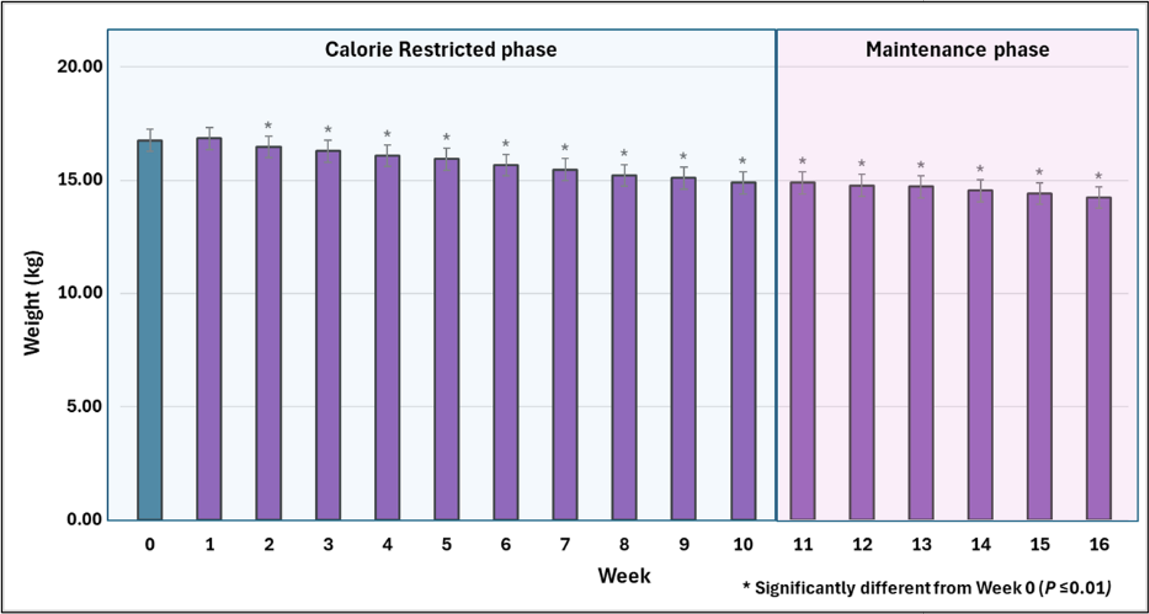
Table 1. Weekly Body Weights
Body weights were recorded weekly. During the 10-week calorie-restricted period, weights decreased by an average of 1.94kg /11.62% with statistical significance by Week 2 (Table 1). All dogs lost weight. During the maintenance feeding period, none of the dogs regained weight.
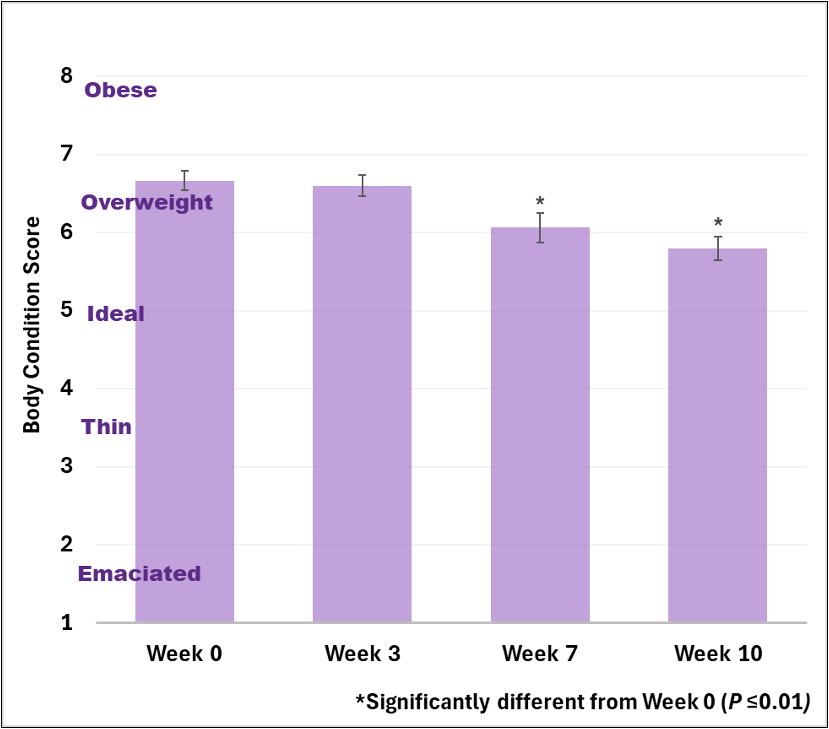
Table 2. Body Condition Scores
Body condition score (BCS) was assessed on Days -1, 21, 49, and 70 using the WSAVA 9-point scale. BCS (Table 2) showed a significant decrease (P<0.01) from an average score of 6.67 at the start of the study to 5.80 at 10 weeks while maintaining a safe rate of weight loss.
Dual-Energy X-ray Absorptiometry (DEXA) scans were conducted at the same time points as the BCS to evaluate fat mass, lean mass, bone mineral content, and percent body fat.
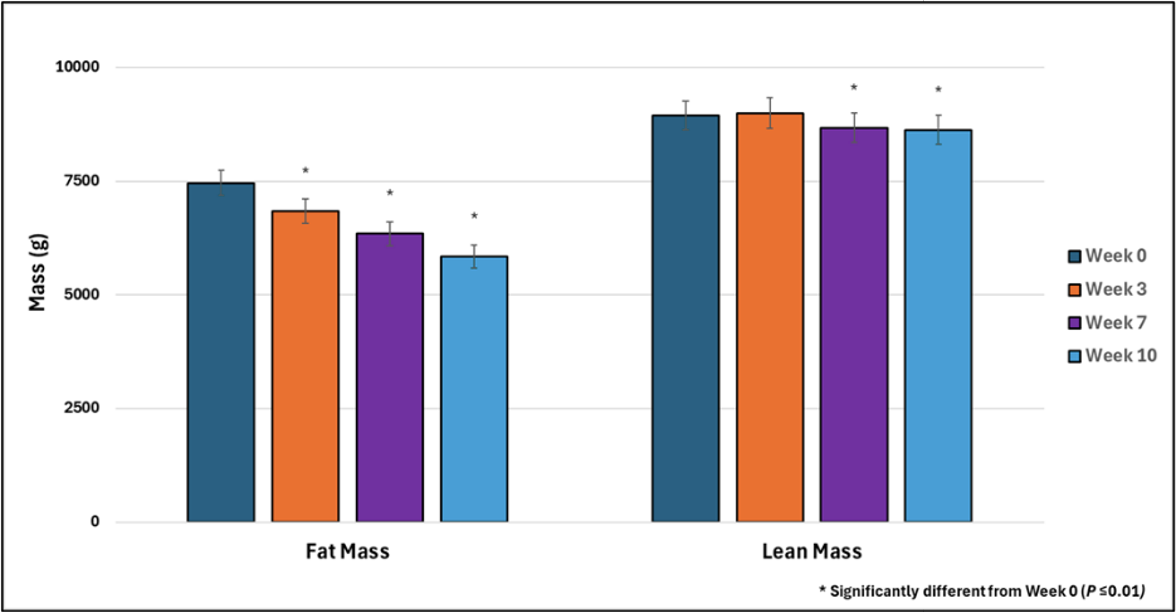
Table 3. Body Composition
DEXA results (Table 3) showed that fat mass decreased by an average of 1.61kg /21.66%, while lean mass stayed relatively stable. This is further demonstrated by the average fat:lean ratio, which decreased (P<0.01) from 0.84 at Week 0 to 0.69 at Week 10. Reduction of both fat mass and fat:lean ratios was significant by Week 3. Furthermore, the DEXA results aligned with those of the everyday clinical tool of the Body Condition Scoring system.
Hematology and serum chemistry panels were performed at baseline and again at Week 10. All dogs were deemed clinically healthy based on physical examination and laboratory findings.
Palatability Studies
Though therapeutic and commercial weight-loss diets can effectively reduce body weight in obese dogs, voluntary intake and long-term compliance can be compromised by palatability challenges, as differences in diet acceptance and voluntary food intake have been documented among weight-loss formulations in dogs.6-8 To address this issue, Wellness offers CORE+ Healthy Weight, which includes highly palatable freeze-dried pieces that can significantly increase mealtime enjoyment and acceptance. In head-to-head palatability studies versus leading weight loss formulas on the market, dogs preferred Wellness CORE+ Healthy Weight.
CONCLUSION
With effective weight loss achieved in 10 weeks and over 80% of dogs maintaining their progress during the maintenance phase, this study shows that high-protein, grain-free formulations like Wellness CORE Healthy Weight provide a clinically supported alternative that preserves lean mass, promotes healthy body composition, enhances palatability, and better aligns with consumer preferences.
Wellness is now offering three high-protein, grain-free diets (Wellness CORE Healthy Weight, Wellness CORE Small Breed Healthy Weight and Wellness CORE+ Healthy Weight) that are not only proven effective for weight and body fat loss but also deliver the quality and taste clients prioritize.
REFERENCES
- Santarossa, A., Parr, J. M., & Verbrugghe, A. (2017). The importance of assessing body composition of dogs and cats and methods available for use in clinical practice. Journal of the American Veterinary Medical Association, 251(5), 521-529.
- Flanagan, J., Bissot, T., Hours, M. A., Moreno, B., Feugier, A., & German, A. J. (2017). Success of a weight loss plan for overweight dogs: The results of an international weight loss study. PloS one, 12(9), e0184199.
- German, A. J., Titcomb, J. M., Holden, S. L., Queau, Y., Morris, P. J., & Biourge, V. (2015). Cohort study of the success of controlled weight loss programs for obese dogs. Journal of Veterinary Internal Medicine, 29(6), 1547-1555.
- Hannah, S. S., & Laflamme, D. P. (1998). Increased dietary protein spares lean body mass during weight loss in dogs. J Vet Intern Med, 12(3), 224.
- Weber, M., Bissot, T., Servet, E., Sergheraert, R., Biourge, V., & German, A. J. (2007). A high‐protein, high‐fiber diet designed for weight loss improves satiety in dogs. Journal of veterinary internal medicine, 21(6), 1203-1208.
- Knight A, Satchell L (2021) Vegan versus meat-based pet foods: Owner-reported palatability behaviours and implications for canine and feline welfare. PLoS ONE 16(6): e0253292.
- Hours, M.A., Sagols, E., Junien-Castagna, A., Feugier, A., Moniot, D., Daniel, I., Biourge, V., Samuel, S., Queau, Y. and German, A.J. (2016). Comparison of voluntary food intake and palatability of commercial weight loss diets in healthy dogs and cats. BMC Veterinary Research, 12(1), p.274.
- Watson, P. E., Thomas, D. G., Bermingham, E. N., Schreurs, N. M., & Parker, M. E. (2023). Drivers of palatability for cats and dogs—what it means for pet food development. Animals, 13(7), 1134.