October 1, 2026
How Premium Wet Food Supports Your Cat’s Sensitive Stomach
Cats have a talent for creating drama in the everyday moments.
They sleep for 16 hours. They demand dinner with the urgency of a five-alarm fire. They stare at an empty bowl as if you personally failed them.
And when their stomach isn’t happy?
They tend to make that pretty obvious, too.
Vomiting. Changes in stool. A sudden loss of interest in food. Or the classic feline maneuver: enthusiastically eating a new food for two days before deciding it is, apparently, unacceptable.
For pet parents, those moments can lead to a lot of questions.
Is it the food?
Is it the routine?
Is my cat simply being a cat?
And, perhaps most importantly, what is the best wet food for cats with sensitive stomachs?
There isn’t one universal answer. Every cat is different, and recurring digestive symptoms should always be discussed with a veterinarian.
But nutrition can play an important role in supporting a cat’s digestive system.
And when you’re evaluating cat food for cats with sensitive stomachs, the conversation should go beyond finding something that’s simply “gentle.”
It should include high-quality protein, moisture, digestibility, prebiotic fiber, essential nutrients, and a complete and balanced nutritional profile.
That’s where premium wet food can have an important place.
Why Cats Can Have Sensitive Stomachs
Cats are creatures of routine.
Change the food. Change the feeding schedule. Change the environment. Add a stressful car ride. Suddenly, the digestive system may have something to say about it.
That doesn’t mean every cat has a medically sensitive stomach. But cats can experience digestive changes when their routines or diets change, particularly when a new food is introduced too quickly.
That’s why one of the simplest principles of feeding a cat is also one of the most important:
Go gradually.
When introducing a new sensitive stomach cat food, transition your cat slowly rather than changing everything overnight. A gradual transition gives the digestive system time to adjust to the new ingredients and nutritional profile.
Consistency matters, too.
But so does what’s actually in the bowl.
If you’re looking for cat food for cats with sensitive stomachs, you’re not simply looking for something your cat will tolerate. You’re looking for nutrition that supports overall health while providing a meal your cat enjoys eating.
And that makes the quality and purpose of each ingredient worth a closer look.
Why Wet Food Can Be a Smart Choice for Sensitive Cats
Wet food brings something dry food can’t quite replicate, and it seems obvious when you see it:
Moisture.
Cats naturally have a relatively low thirst drive, which means food can be an important source of daily water intake. Wet food contains substantial moisture, making it an appealing option for pet parents who want to support hydration alongside nutrition.
High-moisture diets may also be easier for some cats with sensitive stomachs because the food already contains much of the water needed for digestion. Dry food has to absorb moisture in the digestive tract and soften before it can be broken down and moved through the gastrointestinal system. Wet food arrives already soft and hydrated, which can reduce some of that initial digestive work and may make meals feel gentler and easier to process for sensitive cats.
That’s one reason healthy wet cat food can be such an attractive choice.
But moisture isn’t the whole story.
When you’re evaluating premium wet cat food, look at the entire nutritional package.
Does it provide complete and balanced nutrition?
Does it offer high-quality protein?
Does your cat enjoy the texture?
Does the recipe contain ingredients selected for a nutritional purpose?
And does it fit your cat’s individual needs?
Wellness® CORE® Signature Selects was created with those considerations in mind.
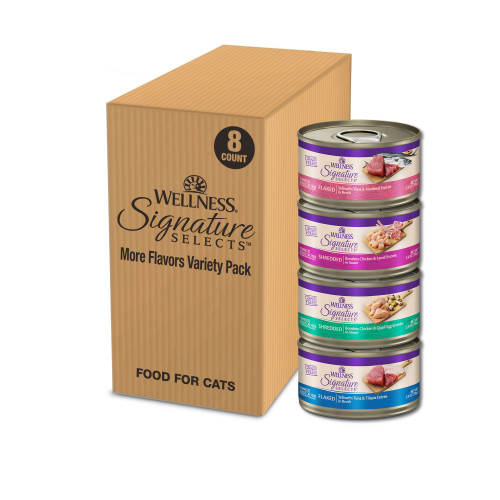
The line features delicate cuts of high-quality meat or seafood in delicious sauces or broths. Each grain-free recipe is hand-packed with real shreds of chicken or flakes of fish and designed to provide essential daily nutrition and hydration.
For cats who prefer a soft, moisture-rich meal, that makes Signature Selects an appealing form of healthy wet cat food.
But there’s more going on inside the can than moisture and flavor.
Some of the most interesting ingredients are the ones you might not immediately think about.
Dried Chicory Root: Feeding the Good Guys
Let’s talk about the gut microbiome.
It’s one of the most interesting areas of nutrition. And it has changed the way we think about digestive health.
Inside your cat’s digestive tract lives a complex community of microorganisms. Some are beneficial. Some are neutral. And maintaining a healthy microbial balance is an important part of overall digestive health.
That’s where prebiotics come in.
Signature Selects contains dried chicory root, which is a natural source of inulin, a type of fiber known as a prebiotic.
Here’s the simple way to think about it:
Probiotics are beneficial bacteria. Prebiotics are the food that helps feed them.
The inulin from chicory root provides fiber that helps nourish beneficial bacteria in the gut, supporting a healthy gut environment.
That makes dried chicory root an important ingredient to understand when you’re exploring prebiotics for cats, cat prebiotics, or a prebiotic cat food.
And the distinction matters.
A probiotic is a live microorganism.
A prebiotic isn’t a microorganism at all. It’s a substrate that beneficial microorganisms can use.
Different jobs.
Same team.
For pet parents interested in cat food for digestive health, that distinction provides a useful way to think about what’s happening inside the bowl—and inside the gut.
Pea Protein in Cat Food: A Plant-Based Protein With a Purpose
Then there’s an ingredient that often gets attention in conversations about feline nutrition:
Pea protein.
Yes, pea protein in cat food is a thing.
And no, it isn’t simply there to fill space.
Signature Selects uses pea protein as a highly digestible source of plant-based protein. It also has an amino acid profile that is particularly rich in lysine.
Why does lysine matter?
Because lysine is an essential amino acid for cats.
“Essential” means the body can’t produce enough of it on its own, so it needs to come from the diet.
Pea protein can play a complementary role in the overall amino acid profile of a recipe, helping complement the amino acids found in other protein sources.
Pea protein also has a lower ash content than animal protein because it comes from a plant-based source. For cats with certain sensitivities, it can provide a grain-free, plant-based protein option as part of a carefully formulated diet.
There’s another reason pea protein can be useful in formulation. It can serve as a grain-free alternative to ingredients such as corn as a source of protein and carbohydrates.
That doesn’t mean pea protein is automatically appropriate for every cat with food sensitivities.
It doesn’t.
Food allergies and intolerances are individual, and your vet can evaluate your cat for food allergies.
But it does mean pea protein in cat food can have a legitimate nutritional and formulation purpose.
The Rest of the Recipe Matters, Too
Digestive health isn’t a one-ingredient equation.
It’s the whole recipe.
Signature Selects includes several other ingredients that contribute to the overall nutritional and sensory experience.
Take marine microalgae oil.
It is a natural source of omega-3 fatty acids, specifically EPA and DHA. The Signature Selects sell sheet notes that it is sourced in the USA and produced through a natural fermentation process, making it a sustainable alternative to sourcing those fatty acids directly from fish.
Then there’s sunflower oil.
It’s a source of unsaturated fatty acids, including linoleic acid, an omega-6 fatty acid that supports healthy skin and a shiny coat. Sunflower oil is also a readily digestible source of fat that provides energy and helps increase caloric density.
And then there are ingredients whose jobs are less glamorous, but still important.
Xanthan gum helps keep nutrients evenly dispersed throughout the food.
Guar gum provides texture and helps retain moisture while contributing soluble fiber that gently supports digestion and stool formation.
Even natural flavor has a job.
It’s used to enhance palatability, helping make the food’s smell and taste more appealing to picky cats.
Because nutritional quality only matters if your cat actually eats the food.
That’s an important part of choosing nutritious wet cat food.
When Easily Digestible Cat Food Means More Than a Marketing Claim
The phrase easily digestible cat food can be misleading.
That’s because digestibility isn’t determined by one magic ingredient.
An entire formulation, including the quality and type of protein, fat, fiber, processing, portion size, and the individual animal, is involved.
That’s why a better question than “Is this easily digestible?” might be:
What makes this food potentially easier for my cat to digest?
With Signature Selects, the answer starts with its formulation.
The recipes feature high-quality meat or seafood, are grain-free, and include ingredients such as pea protein, dried chicory root, and guar gum that each have a defined role in the recipe.
The food also provides moisture through sauces or broths, which can be particularly appealing for cats who prefer wet food.
For pet parents looking for wet cat food for sensitive stomachs, it’s a more useful way to think about the food than simply putting a “sensitive” label on the can.
Look at the formulation.
Look at the ingredients.
Look at the nutritional purpose.
Look at your cat and then consult with your vet.
Texture Matters More Than You Think
Here’s another fact about cats:
They have opinions.
Strong ones.
Some cats want pâté.
Some want shredded meat.
Some want delicate fish flakes swimming in broth.
And some want whatever you happen to be eating.
When you’re searching for Wellness® wet cat food pate, Wellness® kitten pâté, or other forms of healthy wet cat food, texture can be just as important to acceptance as the nutritional profile.
Signature Selects offers variety in both protein and texture.
There are shredded chicken recipes. There are delicate fish flakes. There are sauces and broths.
That variety can help pet parents find a format their cat actually enjoys.
And that’s particularly important when you’re looking for the best wet food for cats with sensitive stomachs.
Because even the most thoughtfully formulated food isn’t doing your cat any good if your cat refuses to eat it.
What About Kittens With Sensitive Stomachs?
Kittens aren’t just cute and cuddly.
They’re growing rapidly and have specific nutritional requirements to support development.
So if you’re searching for Wellness kitten® wet food, it’s important to choose a recipe formulated specifically for kittens rather than simply assuming an adult recipe will provide everything a growing kitten needs.
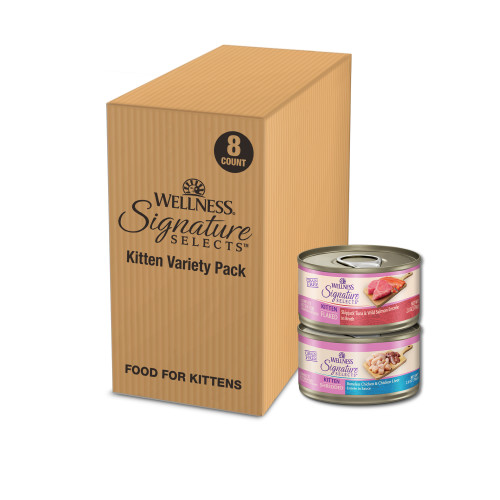
Wellness® offers kitten-specific Signature Selects recipes, including Shredded Chicken & Chicken Liver. You can explore the recipe here.
If you’re specifically looking for wet food for kittens with sensitive stomachs, however, don’t assume digestive problems are simply a quirk of kittenhood.
Persistent vomiting, diarrhea, changes in appetite, or poor growth warrant veterinary attention.
The right Wellness® kitten wet food can provide appropriate nutrition for growth, but food shouldn’t be used to self-diagnose an underlying health problem.
Supporting Your Cat’s Gut Starts With the Whole Bowl
When people hear “sensitive stomach,” they often focus on symptoms.
Vomiting.
Loose stool.
Gas.
Changes in appetite.
But cat digestive health is about more than what happens in the litter box.
The digestive system is responsible for breaking down food and absorbing nutrients, while the gut microbiome adds another layer to the overall digestive-health picture.
That’s why ingredients such as prebiotic fibers are worth understanding.
Dried chicory root provides inulin, a prebiotic that serves as a food source for beneficial gut bacteria.
Guar gum contributes soluble fiber and helps support digestion and stool formation.
And appropriate protein, fat, moisture, vitamins, and minerals all contribute to the nutritional foundation.
In other words, supporting digestion isn’t necessarily about finding one “miracle” ingredient.
It’s about the recipe as a whole.
That’s a much more useful way to think about cat food for digestive health.
So, Is Wellness® Signature Selects Right for a Cat With a Sensitive Stomach?
There isn’t one universal answer.
And that’s actually the point.
If your cat occasionally experiences digestive upset, maintaining a consistent routine and introducing new food gradually may help.
If you’re looking for sensitive stomach cat food, consider a moisture-rich, protein-forward wet food.
If you’re specifically looking for wet cat food for sensitive stomachs, Wellness® CORE Signature Selects offers grain-free recipes featuring high-quality meat or seafood, sauces or broths, pea protein, dried chicory root, and other carefully selected ingredients.
And if you’re looking for premium wet cat food that combines nutrition, hydration, texture, and variety, Signature Selects gives you plenty of options.
But persistent digestive symptoms are different.
If your cat is repeatedly vomiting, experiencing chronic diarrhea, losing weight, refusing food, or showing other signs of illness, talk with your veterinarian.
A “sensitive stomach” can sometimes be a symptom of an underlying condition that needs proper diagnosis.
Food matters.
But so does the bigger picture.
For everyday nutrition, choosing healthy wet cat food with quality ingredients, appropriate nutrients, and plenty of moisture can be an important part of a healthy feeding routine.
And sometimes, supporting your cat’s stomach starts with something surprisingly simple:
A good meal.
A consistent routine.
And a bowl your cat actually wants to finish.
Explore Wellness® CORE Signature Selects.
Frequently Asked Questions About Sensitive-Stomach Cat Food
What is the best wet food for cats with sensitive stomachs?
The best wet food for cats with sensitive stomachs depends on the individual cat.
Look for a complete and balanced diet made with high-quality, digestible ingredients and appropriate levels of protein, fat, fiber, and moisture.
Wellness CORE Signature Selects provides grain-free recipes featuring high-quality meat or seafood in sauces or broths, along with ingredients such as dried chicory root and pea protein.
If your cat has persistent digestive symptoms, consult your veterinarian before changing diets.
Is wet food for sensitive stomachs better for cats?
Not necessarily for every cat.
But wet cat food for sensitive stomachs can offer advantages, particularly its high moisture content and the variety of textures and recipes available.
The most important consideration is whether the food provides complete and balanced nutrition and works well for your individual cat.
What are prebiotics for cats?
Prebiotics for cats are substances that can serve as food for beneficial microorganisms in the gut.
Dried chicory root is a source of inulin, a prebiotic fiber. Wellness explains that the fiber feeds beneficial bacteria so they can support a healthy gut.
That’s why cat prebiotics can be an important part of the conversation around digestive nutrition.
What is a prebiotic cat food?
A prebiotic cat food contains ingredients that provide prebiotic substances or fibers that can support beneficial microorganisms in the gut.
Chicory root is one example. Signature Selects includes dried chicory root, which is harvested to extract inulin.
Is pea protein in cat food good for cats?
Pea protein in cat food can provide a highly digestible source of plant-based protein.
According to the Signature Selects sell sheet, pea protein is particularly rich in lysine, has lower ash content than animal protein because it is plant-based, can complement the amino acid profile of grains and meats, and can serve as a grain-free alternative.
For cats with known food allergies or sensitivities, individual ingredient choices should be discussed with your veterinarian.
Is Wellness CORE wet cat food good for cats with sensitive stomachs?
Wellness® CORE wet cat food includes several wet-food options, including Signature Selects.
Signature Selects features grain-free recipes with high-quality meat or seafood, sauces or broths, and ingredients such as pea protein and dried chicory root.
Whether a particular recipe is appropriate for a cat with digestive sensitivities depends on that cat’s individual needs.
What is Wellness CORE Signature Selects?
Wellness® CORE Signature Selects is a line of gourmet canned cat food featuring delicate cuts of high-quality meat or seafood in sauces or broths.
The line includes 15 artisanal recipes and is made without added meat by-products, corn, wheat, soy, or artificial preservatives, colors, or flavors.
For cats and their humans, it’s a simple idea:
More variety.
More moisture.
More thoughtfully selected ingredients.
And more reasons to look forward to dinner.