November 2, 2026
Traveling With Pets Over the Holidays: The Complete Pet Travel Checklist
A little preparation can turn holiday travel with your dog or cat from stressful to surprisingly smooth. Here’s what to pack, how to maintain their routine, and how to keep them safe, fed, and comfortable along the way.
There are two kinds of holiday travelers.
The people who arrive at the airport three hours early, have snacks organized by category, and know exactly where their passport is.
And then there are the rest of us.
Add a dog or cat to the equation and even the most organized traveler can suddenly find themselves wondering: Did I pack enough food? Where’s the leash? Does the hotel allow pets? When did they last drink water? And why did I think travel with a cat would be easy?
The good news: traveling with pets doesn’t have to be complicated.
It just requires thinking a few steps ahead.
Holiday travel brings some unique challenges for pets. Traveling with pets during the holidays means planning for longer travel days, colder weather, and more unfamiliar environments. Roads and airports are busier. Travel days are longer. Weather can be unpredictable. And once you arrive, your pet may find themselves in an unfamiliar house, hotel room, or relative’s home surrounded by new people, new smells, and possibly a suspiciously enthusiastic toddler.
Don’t try to make the trip exactly like home.
The goal is to bring enough of home with you so your pet knows they’re still safe, fed, hydrated, and cared for.
Here’s how. Whether you’re traveling with dogs or traveling with cats, these pet travel tips can help make the trip more predictable.
Your Holiday Pet Travel Checklist
Before we get into planes, cars, and holiday chaos, start with the basics.
What to Pack for Your Pet
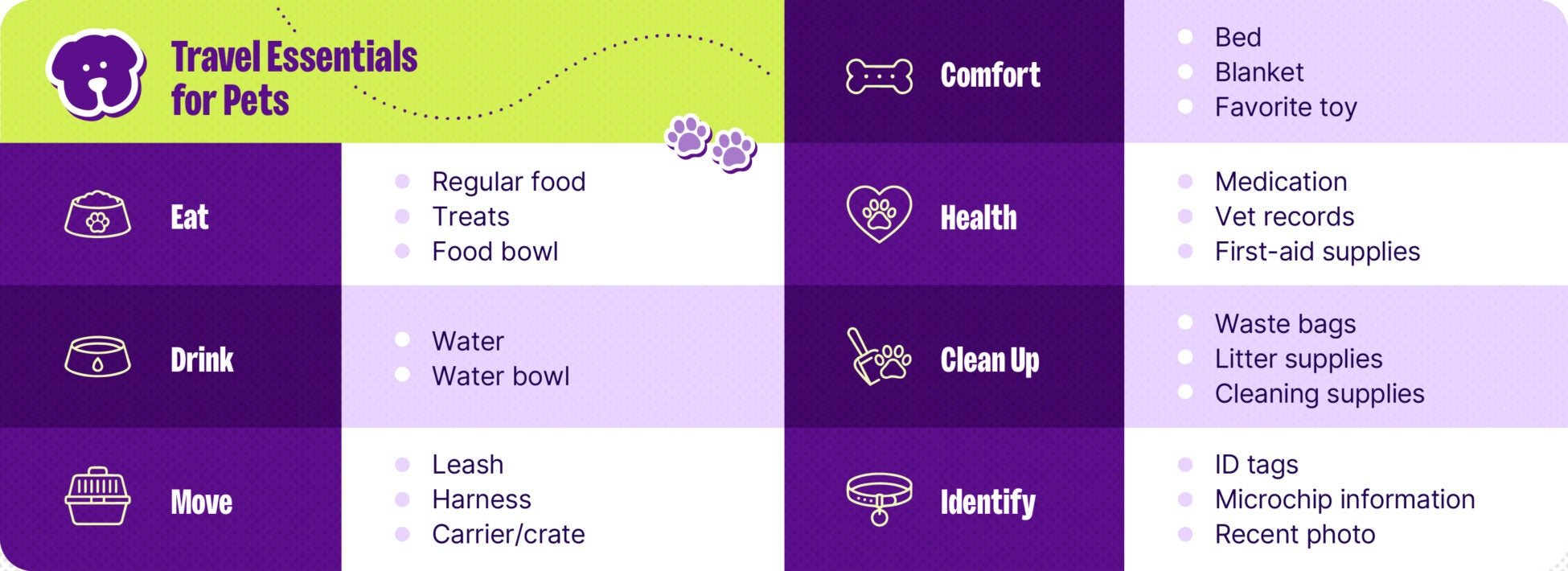
If you’re wondering what to pack for a dog when traveling, start with the essentials below.
What to pack for a cat when traveling includes the same basics, with extra attention to a secure carrier and familiar litter supplies.
Think of this as your pet’s carry-on.
And like your own carry-on, don’t put the important stuff in a bag you’re unlikely to see for 10 hours.
| Pet Travel Essentials | Why It Matters |
| Regular food | Familiar food helps maintain routine and avoid unnecessary stomach upset |
| Treats | Useful for positive reinforcement and familiar comfort |
| Food and water bowls | Collapsible bowls save space |
| Plenty of water | Especially important on long travel days |
| Leash and harness | For safe stops and unfamiliar environments |
| Carrier or travel crate | Essential for cats and useful for many dogs |
| Waste bags/litter supplies | Because holiday magic does not eliminate bathroom breaks |
| Medications | Bring enough for the entire trip, plus extra |
| Veterinary records | Useful in an emergency or when documentation is required |
| ID tags and microchip information | Helps reunite you if your pet gets separated |
| Bedding or favorite blanket | Familiar smells can help reduce stress |
| Favorite toy | A little piece of home |
| Pet first-aid supplies | Helpful for minor problems and unexpected situations |
| Recent photo of your pet | Useful if your pet becomes lost |
| Cleaning supplies | Accidents happen. Be a prepared guest! |
The pet travel essentials above cover the basics most pets need away from home. The American Animal Hospital Association recommends including food, water, bowls, medication, a leash, waste bags, bedding, familiar toys, and first-aid supplies in a pet travel kit. Check out this safety guide for more tips.
The Golden Rule: Don’t Reinvent Your Pet’s Routine
Holiday travel is already a lot of change. For holiday travel with dogs and holiday travel with cats, keeping the basics familiar can make the transition easier.
Your pet doesn’t need a new menu to go with it.
Whenever possible, maintain their normal feeding schedule and bathroom routine. A sudden change in food or diet, combined with a long car ride or flight, is an effective recipe for stomach trouble.
Learn more about the importance of a consistent feeding schedule on the road. This includes regular meal timing to support digestive health, weight management, and energy levels.
For road trips, the American Society for the Prevention of Cruelty to Animals (ASPCA) recommends feeding a light meal several hours before departure rather than feeding a full meal while the vehicle is moving. It also recommends bringing plenty of water.
A Simple Travel-Day Rhythm
| When | What to Do |
| 3–4 hours before departure | Offer a light meal, depending on your pet’s normal routine |
| Before leaving | Bathroom break and some exercise |
| During travel | Offer water regularly |
| Every few hours by car | Stop for a bathroom/stretch break |
| At your destination | Re-establish the normal feeding and bathroom routine |
| Before bed |
The exact schedule should reflect your pet’s normal routine, age, health, and veterinarian’s advice.
The bigger principle is consistency.
How Much Food Should You Bring?
Here’s where holiday travel satisfies even the slightly anxious among us. Bring more food than you think you’ll need.
A good starting point is:
Trip length + 2–3 extra days of food
That gives you a buffer for traffic, weather, flight delays, an unexpected overnight stay, or the classic holiday travel face-palm moment known as “We thought it was only a six-hour drive.”
If you’re traveling somewhere remote or internationally, you might want to increase your buffer.
Keep your pet’s food properly sealed and protected from heat, moisture, and other conditions that could affect freshness. Our guide to pet-food storage offers additional guidance on keeping both food and treats fresh.
And consider convenience.
Dry food is naturally travel-friendly because it doesn’t require refrigeration. Shelf-stable options can be especially handy when refrigeration is limited, or you’re facing off against a long travel day.
Wellness Protein Bowls are shelf-stable, complete meals designed for convenient feeding – great for holiday travel.
The key is to minimize disruption on travel day. Dog food for travel should be what your dog already eats. Make sure it can be stored and served safely.
The best food for traveling with dogs isn’t necessarily a special “travel food.” Look for familiar, complete and balanced food that is easy to transport. A travel-friendly dog food option can be especially useful when refrigeration or kitchen access is limited.
It’s familiar, complete and balanced, and easy for you to safely transport and serve.
Traveling With Pets by Car: Safety First, Scenic Route Second
For many families, the holiday road trip is the easiest way to bring a pet along. But “sitting in the back seat” isn’t the same thing as being safely secured.
The ASPCA recommends using a properly secured crate or carrier, or an appropriate restraint. Pets should not ride in the front seat where airbags can cause serious injury. Here are some travel safety tips for you and your furry friend.
The basic rule: if you wouldn’t want your pet injured during a sudden stop, secure them.
Dogs
Use an appropriate travel crate or restraint system designed for your dog.
Cats
Keep cats in a secure carrier. A loose cat in a moving vehicle is a safety hazard for everyone, including the cat.
Everyone
Keep food, medications, and other potentially dangerous items secured and out of reach.
Wellness’s existing guide to traveling with pets safely also recommends acclimating pets to car travel with short drives before a major trip.
Start with a trip around the block.
Then a longer drive.
Then perhaps the ultimate test: a trip to somewhere that isn’t the veterinarian or groomer.
And Never Leave Your Pet Alone in the Car
Not for coffee.
Not for “just five minutes.”
Not even if it’s December and it feels cold outside.
Cars can become dangerously cold in winter, and pets can be vulnerable to temperature extremes. The CDC recommends taking precautions to protect pets during travel and checking conditions at your destination.
Build bathroom and stretch breaks into the trip instead. Your dog will probably vote for more stops anyway.
Flying With Pets? Start Earlier Than You Think.
Flying with pets requires another level of planning.
First, check the airline’s current pet policy before booking. Requirements can vary by airline, aircraft, route, and whether your pet is traveling in the cabin or another area.
Then check the destination’s requirements.
For domestic travel, states may have their own rules. International travel requirements can include vaccinations, microchips, health certificates, permits, testing, and other documentation. The Animal and Plant Health Inspection Service (APHIS) and the U.S. Department of Agriculture (USDA) recommend checking destination requirements before traveling.
If you’re flying, don’t wait until the week before Christmas to discover that your pet needs paperwork.
Airport Reality Check
Airports are already sensory overload for humans.
For pets, they’re a whole different universe.
New smells. Strange noises. Crowds. Rolling suitcases. Security checkpoints.
That’s why preparation matters. If you’re researching how to travel with a dog, practice the carrier, restraint, and vehicle routine before the holiday trip. If you’re figuring out how to travel with a cat, carrier practice is especially important.
If your pet is flying, talk with your veterinarian about whether your pet is a good candidate for air travel and what feeding, medication, or carrier considerations apply.
For specific airline requirements, always check directly with the airline before departure.
How to Keep Pets Calm While Traveling
You can’t explain turbulence to a dog.
You can’t tell a cat that the hotel room is temporary.
And neither one is particularly interested in your carefully constructed itinerary.
What you can do is reduce the number of unfamiliar things happening at once.
Familiarity is your secret weapon.
Bring something that smells like home: a favorite blanket, bed, toy, or towel.
Keep meals familiar. Use the same food and treats.
Maintain familiar commands and routines. Give your pet opportunities to exercise before long stretches of travel.
And practice with the carrier or vehicle before the big day.
Bring familiar items such as a favorite toy, pillow, blanket, and food to help pets feel more comfortable while traveling.
Dog anxiety while traveling is real. Discuss with your veterinarian how to manage motion sickness or other health concerns. Don’t improvise with medication. Your veterinarian can help determine what, if anything, is appropriate for your particular pet and situation.
Don’t Forget Hydration
When traveling, it’s surprisingly easy to overlook normal water habits.
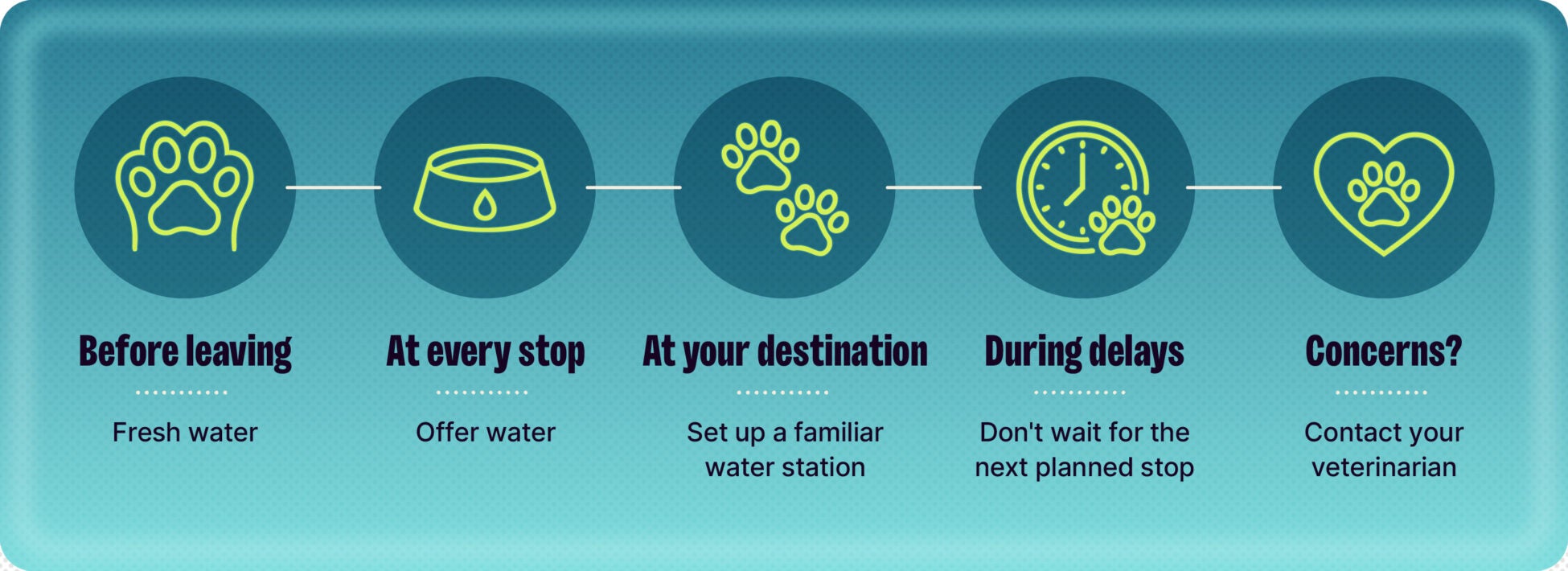
Make hydration part of your travel routine rather than waiting until your pet seems thirsty.
For road trips, bring water from home or bottled water, particularly if your pet has a sensitive stomach. Offer water during regular stops.
A collapsible bowl makes this considerably easier.
Wellness’s article on supporting pet hydration also explores how moisture-rich food can complement your pet’s overall hydration routine.
For cats, hydration deserves particular attention. Wellness’s guide to dehydration in cats notes that fresh, clean water should always be available. Low energy, loss of appetite, and dry or sticky gums can signal dehydration. Keep an eye on your feline friend.
Arriving at the Hotel: Do a Pet’s-Eye Inspection
Congratulations. You’ve arrived.
Now, resist the temptation to open the carrier and immediately let your pet investigate the entire room.
Do a quick safety check first.
Look under beds and furniture. Check for medications, food, small objects, loose cords, toxic plants, or other hazards.
For cats, check especially carefully for places they could hide or become trapped.
For dogs, check doors, balconies, gates, and any possible escape routes.
Then establish a little “home base.” Put their bed or blanket in one place. Set up food and water. Keep their familiar food and treats nearby. You’re not recreating home. You’re giving them an anchor.
Finding Pet-Friendly Accommodations
“Pet-friendly” doesn’t always mean “pets are welcome everywhere.” Before booking, confirm:
- Whether dogs, cats, or both are allowed
- Weight or breed restrictions, if applicable
- Pet fees or deposits
- Number of pets allowed
- Whether pets can be left unattended
- Where pets can go outside
- Whether there are nearby walking areas
- Whether food and water bowls are provided
- Whether there are restrictions on pets being on furniture or beds
These practical pet friendly travel tips can make an unfamiliar destination easier to navigate.
And before you arrive, find the nearest veterinary clinic and emergency veterinary hospital.
Hopefully you’ll never need either.
That’s exactly why it’s useful to know where they are.
Holiday Travel Has One More Variable: Other People
For holiday travel with pets, familiar routines matter even more when the destination is full of people, noise, and activity.
This is the part of holiday travel with pets that doesn’t always make it onto the packing list.
People. Lots of them. Your dog may love a house full of relatives. Your cat may prefer to file a formal complaint and hide underneath the bed. Either response is normal.
Don’t assume that because your pet is friendly at home, they’ll want to interact with every person they meet.
Give them an escape route. A quiet room. A crate. A bed in a low-traffic corner. A little time away from the holiday action.
Our holiday pet-safety guidance recommends creating a quiet, familiar space where pets can retreat from holiday activity, complete with familiar bedding, toys, and water.
Think of it as their version of stepping outside for some fresh air.
The Holiday Delay Plan
Here’s the travel tip nobody wants to need:
Pack for the trip you planned and the trip you didn’t.
A snowstorm can turn six hours into twelve. A canceled flight can become an overnight stay. A missed connection can turn “we’ll be home tonight” into “where’s the nearest pet-friendly hotel?”
Your emergency buffer should include the following pet travel essentials:
| If Plans Go Sideways… | Have This Ready |
| Traffic doubles the drive | Extra food + water |
| Flight gets delayed | Food + treats + water |
| Overnight stay becomes necessary | Bedding + medication + cleaning supplies |
| Luggage gets separated | Food + medication in your carry-on |
| Pet gets lost | Current ID + microchip information + recent photo |
| Weather changes | Appropriate gear + extra supplies |
| Destination changes | Pet-friendly lodging information |
This may seem like overpacking. But if the unexpected happens, you’ll be glad you gave yourself options.
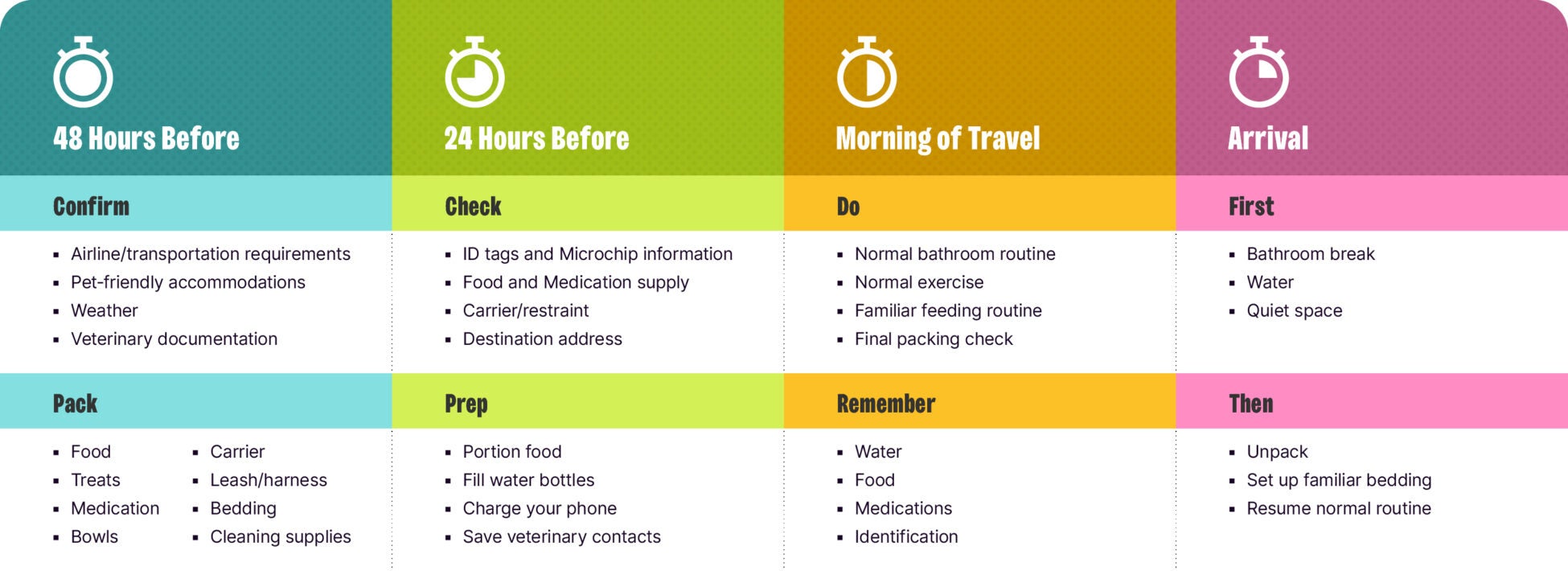
The 48-Hour Pet Travel Countdown
48 HOURS BEFORE
Confirm
- Airline or transportation requirements
- Pet-friendly accommodations
- Weather
- Veterinary documentation
Pack
- Food
- Treats
- Medication
- Bowls
- Carrier
- Leash/harness
- Bedding
- Cleaning supplies
24 HOURS BEFORE
Check
- ID tags
- Microchip information
- Food supply
- Medication supply
- Carrier/restraint
- Destination address
Prep
- Portion food
- Fill water bottles
- Charge your phone
- Save veterinary contacts
MORNING OF TRAVEL
Do
- Normal bathroom routine
- Normal exercise
- Familiar feeding routine
- Final packing check
Remember
- Water
- Food
- Medications
- Identification
ARRIVAL
First
- Bathroom break
- Water
- Quiet space
Then
- Unpack
- Set up familiar bedding
- Resume normal routine
The Complete Holiday Pet Travel Game Plan
Use this as your final pet travel checklist before you leave. It can also serve as a simple dog travel checklist or cat travel checklist, depending on who is coming along.
If you want to simplify everything above, remember these five principles:
1. Familiar beats fancy
Bring the food, treats, bedding, and routines your pet already knows.
2. Secure beats convenient
A carrier or properly fitted restraint may feel restrictive, but safety comes first.
3. Routine beats improvisation
Keep feeding, hydration, bathroom, and exercise schedules as consistent as possible.
4. Extra beats exactly enough
Bring extra food, medication, and supplies in case your travel plans change.
5. Calm beats rushed
Build more time into your travel day than you think you’ll need.
A Final Word for the Holiday Road
The best part of traveling with pets isn’t that they make the trip easier.
They don’t.
They make you stop. You stop for bathroom breaks. You stop for water. You stop because your dog has decided that this particular patch of grass requires extensive research.
You slow down. And maybe that’s not the worst thing during the holidays.
Because underneath all the flights, traffic, packing lists, and logistics, traveling with pets is really about bringing a little bit of home with you.
Give them familiar food.
Give them familiar comforts.
Give them time.
Give them a safe place to settle in.
And when the holiday travel gets hectic, remember: your pet doesn’t care whether you arrive exactly on schedule.
They just want to arrive with you.
Holiday Pet Travel FAQ
How to travel with a dog during the holidays?
If you’re wondering how to travel with a dog, start by maintaining your dog’s normal routine and bringing familiar food, water, treats, and bedding. Secure your dog properly in the car with a carrier, crate, or appropriate restraint, and plan regular bathroom and exercise breaks. For air travel, check the airline’s current requirements and your destination’s regulations well in advance.
What should I pack when traveling with my dog?
Use the dog travel checklist above, especially the sections on food, water, identification, medication, and familiar comfort items.
Bring your dog’s regular food, treats, water, bowls, leash, harness or carrier, waste bags, medications, veterinary records, identification, bedding, favorite toys, and basic first-aid supplies. Pack extra food and medication to account for travel delays.
How to travel with a cat for the holidays?
Traveling with cats requires transportation in a secure carrier. Familiar bedding or a favorite item can make the carrier and destination feel less unfamiliar. Keep their food and routine consistent, and never allow a cat to roam loose inside a moving vehicle.
How do you keep pets hydrated while traveling?
Hydration is one of the most important pet travel tips, especially on long travel days.
Bring water from home or bottled water and offer it regularly during travel. On road trips, provide water during planned stops. A collapsible bowl makes hydration easier when you’re away from home.
What is the best food to bring when traveling with a dog?
The best food for traveling with dogs is the one your pup already knows and tolerates well.
The best travel food is generally food your dog already eats successfully at home. Avoid introducing an entirely new diet immediately before or during a long trip. Dry food and appropriately packaged shelf-stable foods can be convenient for travel because they are easier to transport and don’t require refrigeration.
How long can a dog travel without eating?
There isn’t one safe duration that applies to every dog. Age, size, health, medications, activity level, and normal feeding schedule all matter. Rather than intentionally extending the time between meals, maintain your dog’s usual routine as much as practical and ask your veterinarian about feeding before and during a long trip.
How do you maintain a dog’s routine while traveling?
Keep meals, bathroom breaks, exercise, and bedtime as close to your normal schedule as possible. Bring familiar food, treats, and bedding. The more predictable the basics remain, the fewer changes your dog has to process at once.
What are the best tips for a holiday road trip with a dog?
Establishing simple priorities makes traveling with dogs more enjoyable. Secure your dog, maintain the routine, and build in extra time.
Secure your dog properly, plan regular stops, bring familiar food and water, pack extra supplies, and never leave your dog unattended in a parked vehicle. Start preparing before departure with a few shorter practice drives if your dog isn’t accustomed to traveling.